The Complete Guide to Game Classification: Sorting Games by Platform, Perspective, Player Count, Business Model, Genre, and Rating
A guide to classifying games by six criteria (platform, camera perspective, player count, business model, genre, and age rating), with a summary table comparing the main categories under each one.
There are many ways to answer the question "What kind of game is it?" You might say "It's a Switch game," "It's first-person," "It's something you play with three friends," "It's free but sells items," "It's a roguelike," or "It's rated 15+." All of these are correct, but each describes the game by a completely different standard.
Game classification is not a system with a single right answer. It works by layering several axes on top of one another. The same game can be a mobile game by platform, a top-down game by perspective, a single-player game by player count, a free-to-play game by revenue model, and a tower defense game by genre.
In this post, we go through the six main criteria for classifying games one by one: platform, perspective, player count, business model, genre, and age rating. At the end, we include a summary table that shows all of them at a glance.
Why Game Classification Uses Multiple Axes
English Wikipedia describes video game genres as an informal classification based not on visual or narrative elements but on how the game is played. A shooter is a shooter whether it is set in space or the Wild West. But when people choose a game, genre is not the only thing they want to know. Whether it runs on their device, whether they can play with friends, how much it costs, and whether it is suitable for their kids all matter too. That is why several other classification axes are used alongside genre.
Attempts to categorize games go back a long way. According to Wikipedia, the 1981 Atari VCS catalog grouped games under eight headings such as "Skill Games," "Race Track," "Sports Arena," and "Combat Zone." When Nintendo launched the NES in North America in 1985, it divided games into eight series, including adventure, action, sports, light gun, and educational, and marked them on the boxes. Game designer Chris Crawford proposed a classification system in a 1984 book, and noted himself that because game design was changing so quickly, his classification would soon become outdated. Indeed, the ways games are classified are still changing today.
1. Platform: Where Do You Play?
The platform is the device and environment that runs the game. It is also the first criterion you should check. No matter how fun a game is, you cannot play it if it does not run on your device.
| Platform | Characteristics | Examples |
|---|---|---|
| Arcade | Dedicated machines, coin-operated, motion and physical controls | Pong, Pac-Man, rhythm game cabinets |
| Home console | Dedicated game machines connected to a TV | PlayStation, Xbox, Nintendo Switch |
| Handheld console | Dedicated portable devices | Game Boy, Nintendo DS, PSP |
| PC | Keyboard and mouse, varied specs, modding culture | Digital stores such as Steam |
| Mobile | Smartphones and tablets, touch controls, app stores | Google Play and App Store games |
| Web browser | Runs instantly without installation | Flash games, HTML5 games |
| VR/AR | Headsets or cameras that combine with the real world | Beat Saber, Pokémon GO |
| Cloud | Runs on a server and streams only the screen to you | Game streaming services |
Platforms also strongly shape game design. Arcade games are made short and intense so a single coin buys a few minutes of fun, mobile games are built for touch and short play sessions, and PC games are designed for precise mouse control and long sessions. From the Magnavox Odyssey (1972), regarded as the first home game console, to today's smartphones, every new platform has given rise to new genres suited to it.
2. Perspective: How Do You See It?
Perspective is where the camera shows the game world from. Wikipedia describes first-person and third-person as the two perspectives used by most video games.
- First-person: You see through the character's eyes. It offers strong immersion and is common in FPS games, flight and driving simulators, walking simulators, and visual novels.
- Third-person: You see from behind or beside the character. Because you can see both the surroundings and the character's movement, it is common in action-adventure games.
- Top-down: Good for seeing a wide area of the battlefield, it has been widely used in strategy, tower defense, and early racing and sports games.
- Isometric: A view looking down at an angle from above, giving both a sense of space and a wide field of view. It is often used in simulation games and RPGs.
- Side-scrolling (side view): You view the action from the side as it progresses left and right. It is the default perspective for platformers and fighting games.
Note that a perspective name sometimes becomes part of a genre name, as in "first-person shooter (FPS)." Wikipedia explains that FPS and TPS have come to refer to specific subgenres of shooters, not simply to every game that uses those perspectives.
3. Player Count: Who Do You Play With?
| Type | Meaning | Examples |
|---|---|---|
| Single-player | Playing alone against the computer or a story | Most story-driven games |
| Local multiplayer (couch co-op) | Playing together on one device and one screen | Party games, fighting games |
| Online co-op (PvE) | Several players teaming up against the computer or the environment | Co-op survival games, raids |
| Online competitive (PvP) | Competing directly against other people | Fighting games, MOBAs, battle royales |
| Massively multiplayer (MMO) | Huge numbers of people sharing one world | MMORPGs |
| Asymmetric multiplayer | Each side has different abilities and goals | One player is a monster, the rest are survivors |
Wikipedia defines a multiplayer game as one in which two or more people can play in the same game environment at the same time. Spacewar!, made at MIT in 1962, is cited as an early example, and Pong was also a game played by two people facing each other. Player count greatly changes a game's atmosphere. Even within the same genre, a game can be a calm puzzle when played alone and a noisy party game when played with four people.
4. Business Model: How Do You Pay?
Wikipedia broadly divides video game monetization into six methods: retail sales, digital distribution, subscriptions, microtransactions, player-to-player trading, and advertising, and notes that a single game can use several of them together. From the consumer's point of view, they can be summarized as follows.
| Model | How it works | Characteristics |
|---|---|---|
| Boxed or paid purchase (premium) | Buy once up front and keep playing | Little pressure to make additional payments |
| Subscription | Pay a monthly fee to play | Online game passes, game library subscription services |
| Free-to-play (F2P) | Free to start, with items and convenience features for sale | Low barrier to entry, possible "pay-to-win" controversy |
| Ad-supported | Play for free and watch ads | Common in casual mobile games |
| Additional content (DLC) and season passes | Expansions and new modes sold separately from the main game | Used by both paid and free games |
| Loot boxes | Selling boxes whose contents are unknown | Subject to regulation and debate |
The business model is also tied to game design. Wikipedia explains that free-to-play games differ from completely free "freeware," which is why they are sometimes called "free-to-start" games. Even among puzzle games, a game you buy once is often designed for a smooth experience from start to finish, while an ad-supported game is often designed around short rounds and natural break points.
5. Genre: What Do You Do?
Genre is the most widely used classification, but also the one with the blurriest boundaries. Wikipedia also explains that genres can be interpreted subjectively and that a single game can belong to several genres at once. The main broad genres are as follows.
- Action: Focused on reaction speed and controls. Platformers, shooters, fighting games, and more
- Adventure: Focused on exploration, story, and puzzle-solving
- Role-playing (RPG): Character growth and story
- Strategy: Judgment and planning. Real-time strategy, turn-based strategy, tower defense, and more
- Simulation: Turning real-world activities into rules. Management, life, and vehicles
- Sports and racing: Recreating real matches and races
- Puzzle: Logic and pattern matching
- Rhythm: Inputs timed to the beat of music
- Survival and crafting: Gathering resources and making tools to hold out
There are also exceptions like horror, which is grouped by "the emotion it creates" rather than by how the game is played. It is also common for the name of a landmark game to become a genre name, as with "Metroidvania," "Soulslike," and "roguelike." Genre names often combine two words, like "action RPG" or "puzzle platformer," because genres mix with each other so often.
6. Age Rating: Who Can Play It?
An age rating is a classification that tells you what age the content is suitable for, not how difficult the game is. Each country has its own organizations and standards.
| Region | Organization | Main ratings |
|---|---|---|
| South Korea | Game Rating and Administration Committee (GRAC) | All ages, 12, 15, Adults only |
| North America | ESRB | E (Everyone), E10+, T (13+), M (17+), AO (18+) |
| Europe | PEGI | 3, 7, 12, 16, 18 |
| Japan | CERO | A (All ages), B (12+), C (15+), D (17+), Z (18+) |
| Online and apps | IARC | Assigns ratings for each country's standards at once based on questionnaire answers |
One difference is that South Korea's system is closer to a statutory review in which a government agency decides ratings, while ESRB, PEGI, and CERO started as industry self-regulation. In places like app stores, where many games are uploaded every day, the IARC system is used, in which a rating is determined automatically once the developer answers a questionnaire. We cover this in more detail in a separate post on game rating systems on this blog.
Game Classification Summary Table
| Criterion | Question it asks | Main categories | What to check |
|---|---|---|---|
| Platform | Where do you play? | Arcade, console, handheld, PC, mobile, web, VR, cloud | Whether your device is supported, control method |
| Perspective | How do you see it? | First-person, third-person, top-down, isometric, side-scrolling | Immersion and field of view, motion sickness |
| Player count | Who do you play with? | Single-player, local multiplayer, online co-op, online competitive, MMO, asymmetric | Whether you can play with friends |
| Business model | How do you pay? | Paid purchase, subscription, free-to-play, ads, DLC, loot boxes | Total cost, how much pressure there is to pay |
| Genre | What do you do? | Action, adventure, RPG, strategy, simulation, sports, racing, puzzle, rhythm, survival, horror | Whether it's the kind of fun you like |
| Age rating | Who can play it? | GRAC, ESRB, PEGI, CERO, IARC | Whether it's suitable for children |
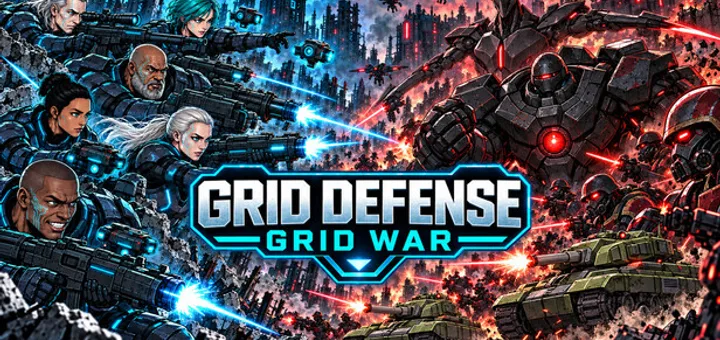
Using this table is simple. Pick a game and answer the question in each row one at a time. For example, KEKE STUDIO's GRID DEFENSE: GRID WAR is a mobile game by platform (with a PC Steam version in preparation) and a sci-fi tower defense game (a subgenre of strategy) by genre, while Sugar Pop Blocks can be classified as a mobile candy block puzzle. Describing a game along several axes like this helps someone seeing it for the first time picture what it looks like much more accurately.
Game classification is less a set of walls that box games in and more a map that helps you find the games you want. Genres keep mixing, platforms keep multiplying, and business models change with the times. Even so, the six questions of "where, seen how, with whom, for how much, doing what, and suitable for whom" will remain a good starting point for understanding games.