The History of Tower Defense and What Makes It Fun
Tower defense history from Rampart and StarCraft custom maps to Plants vs. Zombies, Kingdom Rush, and Bloons TD, plus how paths, upgrades, and waves work.
Tower defense is a genre whose rules fit in a single sentence: "Enemies are marching down a path, so build towers along it and stop them from reaching the end." Yet for over 30 years, that simple rule has kept producing new games.
In this post, we trace how tower defense started from arcade games, passed through user-made maps for real-time strategy games and Flash games in web browsers, and became a signature mobile genre. In the second half, we look at why the genre is fun by breaking it into three design elements: paths, upgrades, and waves.
What Is Tower Defense?
Tower defense (TD) is a subgenre of strategy games in which you place defenses to keep attacking enemies from reaching a goal. Its defining feature is that the player doesn't control units directly. The player's job is to decide where, what, and when to build, and the towers do the actual attacking automatically.
Because it often plays out in real time, it's classified as a branch of real-time strategy (RTS), but these days many games have a turn-based feel, letting you pause between waves to think.
Early Roots: Defense Games in the Arcade
The idea of "protecting something" goes back a long way. Space Invaders (1978) had shields that covered the player, and Missile Command (1980) was about defending cities from missiles. These, however, were action games where the player aimed and fired directly.
The game most often cited as the genre's prototype is Rampart, released for arcades by Atari Games in 1990. Rampart alternated between a building phase, where you put up castle walls, and a battle phase, where you fought off enemies with cannons. The flow of placing defenses yourself and repairing them when they break resembles the basic structure of later tower defense games.
The Custom Map Era: StarCraft and Warcraft III
Tower defense took its modern form in user-made maps for real-time strategy games, commonly called "custom maps" (or "UMS maps").
Blizzard's StarCraft: Brood War included a map editor, and players used it to create maps with rules completely different from the original game. Maps like "Turret Defense" (May 2000) and "Sunken Defense" (November 2001) are typical examples. Enemy units entered along a set path, and players built defensive structures beside it to stop them.
The World Editor in Warcraft III (2002) and its 2003 expansion The Frozen Throne offered far more freedom. With the ability to create new units and abilities, maps such as Element TD, built around elemental strengths and weaknesses, and Gem Tower Defense, where you combine random gems, appeared. Considering that the same editor also gave rise to DotA, the start of the MOBA genre, it's clear how many genres the custom maps of this period nurtured.
The Flash Game Boom: Popularity Explodes in the Browser
Around 2007, tower defense grew from a pastime of RTS players into a genre anyone could enjoy. The catalyst was Flash games in web browsers.
- Flash Element TD (January 2007): Brought the fun of the Warcraft III map to the browser.
- Desktop Tower Defense (March 2007): Made by Paul Preece, it had no set path; you placed towers on an empty desktop to build the maze enemies would walk through. According to Wikipedia, it had been played more than 15.7 million times by July 2007.
- Bloons Tower Defense (2007): Made by New Zealand's Ninja Kiwi, it had a cute premise of monkeys throwing darts to pop balloons. The series continued, eventually reaching Bloons TD 6 in 2018.
In 2008, games like Defense Grid: The Awakening, PixelJunk Monsters, and GemCraft came out on PC and consoles, establishing the genre in commercial games.
The Mobile Era: Plants vs. Zombies and Kingdom Rush
When Apple's App Store opened in 2008, it became clear that tower defense was a great fit for touchscreens. Tapping a spot with your finger to build a tower felt even more natural than using a mouse. Fieldrunners, released exclusively for iOS in October 2008, was an early standout.
Plants vs. Zombies, released by PopCap Games in May 2009, broadened the genre further. Zombies walk toward your house along several rows (lanes), and you collect "sun" to plant plants that stop them. Paths were simplified into straight lanes, but each plant had a distinct personality, so even people trying tower defense for the first time could easily understand it. It came out on PC first and was later ported to consoles and mobile.
Kingdom Rush, made by Uruguay's Ironhide Game Studio and published by Armor Games in 2011, refined the classic approach of building towers in fixed spots beside a fixed path. It narrowed tower types down to four branches but added upgrades, hero units, and soldiers that block the path, giving players more decisions to make. Wikipedia's tower defense article states that Kingdom Rush has sold more than 17 million copies on the App Store and Play Store.
After that, combinations with other genres became common, such as Sanctum (2011), which mixed in first-person shooting; Anomaly: Warzone Earth (2011), a "reverse tower defense" that flipped attack and defense; and Arknights (2019), which combined the genre with character collecting.
What Makes It Fun, Part 1: Designing the Path
The fun of tower defense comes mainly from three design elements. The first is the path.
| Type | Description | Examples |
|---|---|---|
| Fixed path | Enemies move only along a predetermined route; towers are placed beside it | Kingdom Rush, Bloons TD |
| Lanes | Multiple straight paths, each defended separately | Plants vs. Zombies |
| Free maze | Towers act as walls; the player creates the path | Desktop Tower Defense |
In fixed-path games, the most important spots are "where the path bends." Placing area-damage towers where enemies linger greatly improves efficiency. In free-maze games, "mazing," using towers to make the path wind back and forth so enemies walk farther, becomes the core skill. Either way, players read the map and solve the puzzle of finding where enemies will take the most hits.
What Makes It Fun, Part 2: Upgrades and Choices
The second is resources and upgrades. Defeating enemies earns money, and you have to decide whether to spend it on new towers or on strengthening existing ones.
- Building many new towers covers a wide area, but each one is weak.
- Maxing out a single tower makes it powerful, but the places it can't reach become weak points.
- When upgrades branch, as in Bloons TD 6 or Kingdom Rush, the same tower can take on different roles.
There's no single right answer to these choices. Since different people clear the same map in different ways, there's always a reason to play again.
What Makes It Fun, Part 3: Waves and the Rhythm of Tension
The third is waves. Enemies don't come all at once; groups of set numbers and types arrive one after another.
The wave structure creates a natural rhythm. Between waves, there's time to catch your breath and tune your towers; during a wave, there's the tension of watching whether your defenses will hold. Good tower defense poses a new problem with each wave. When fast enemies, tough enemies, flying enemies, and invisible enemies come mixed together, one type of tower can't stop them all, and players have to think about combinations. The boss in the final wave serves as a graduation exam, testing the defenses you've built up.
In short, tower defense is a game where you read space through paths, divide resources through upgrades, and endure time through waves. That's why your palms sweat even though you never fight directly.
Tower Defense Today
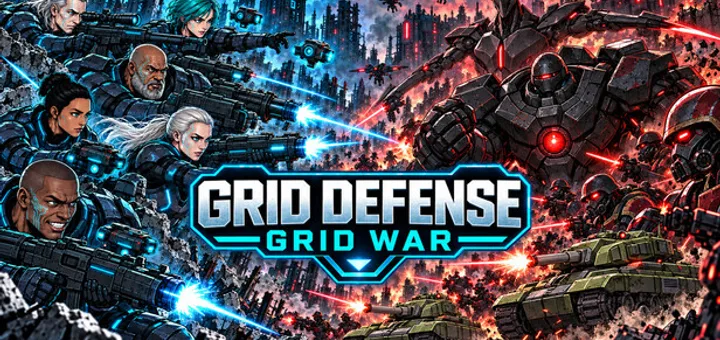
Today, tower defense keeps expanding, with directly controlled heroes, special one-shot skills, and blends with other genres. Keke Studio's GRID DEFENSE is part of this trend: a sci-fi tower defense set in real cities, with heroes, nuclear strikes, and aircraft carrier battles added. It's currently available on the App Store and Google Play, and a Steam release is in preparation.