Game Sound Design: How Sound Becomes Half the Game
From Space Invaders' quickening beat and Koji Kondo's Mario music to Silent Hill's static, Dead Space, and Journey: the principles of game sound design.
Have you ever played a game with the sound off? The screen is the same, but somehow it feels flat. Guns look weightless, jumps feel sluggish, and scary scenes aren't scary at all. Because sound is invisible, it's easy to forget, but it plays as big a role as the screen in determining how a game feels.
In this post, we look at what game sound design does, the roles that sound effects, music, and ambience each play, and how "reactive sound" that changes with the player's actions has evolved, using well-known games as examples. Finally, we share what a small studio pays attention to when working with sound.
The Three Layers of Game Sound
Game sound is usually thought of in three layers.
| Layer | Examples | Main Role |
|---|---|---|
| Sound effects (SFX) | Footsteps, gunshots, coin sounds, button clicks | Communicate the results of actions and create game feel |
| Music (BGM) | Theme songs, battle music, boss music | Drive emotion and pace |
| Ambience | Wind, rain, machinery noise, crowds | Make a space believable |
Dialogue and narration are added on top of these. A sound designer's job is not only to make each layer well but also to arrange them so they don't clash when they play at the same time. If an important warning sound gets buried under the music in the middle of a battle, the design has failed no matter how good the sounds are.
Sound Is Information
The first role of game sound is to convey information. The screen shows only the direction the player is facing, but sound comes from all around.
Space Invaders (1978) is regarded as the first game to use continuous background music. It was a simple repeating sequence of four low notes, but the tempo sped up as the aliens descended. Players could feel danger approaching with their ears, without even looking at the screen. The sound itself became a gauge of tension.
In Silent Hill (1999), the protagonist gets a portable radio early on. The radio crackles with static when monsters are nearby. In a game where fog and darkness make it hard to see ahead, the static becomes both the most important warning and the scariest sound. You can turn the radio off if you want, but then you lose the information. It's a clever design that ties information and fear to a single sound.
The developers of Dead Space (2008) wanted players to use sound as a cue to anticipate enemy attacks, while at the same time becoming more frightened because of that sound. They watched their favorite horror films and analyzed how sound effects and music were used, aiming to recreate film-style scripted scares in an interactive space.
Sound Is Game Feel
The second role of sound effects is to create game feel, the tactile sense of the controls. The same gun looks powerful with a heavy firing sound and the clink of falling shell casings, but feels like a toy with a light sound.
Good sound effects share a few traits.
- They're heard immediately. The sound must play the instant the button is pressed. Even a short delay makes controls feel sluggish.
- They don't get tiresome when repeated. For sounds you'll hear thousands of times, vary the pitch or sound slightly so they don't sound exactly the same every time.
- Good and bad outcomes sound different. Success sounds are often made bright and rising, failure sounds low and dull.
- Volume has a hierarchy. The more important the event, the louder and clearer the sound; the more trivial the action, the quieter.
The Dead Space team used human sounds as the basis for its monster sounds, and in one area with no enemies it used sounds recorded on the San Francisco Bay Area Rapid Transit (BART), which producer Glen Schofield described as a horrific sound. Twisting everyday sounds to make them unfamiliar is a common technique in horror games.
Music Is Movement: Koji Kondo and Super Mario
Koji Kondo is a composer who joined Nintendo in 1984 and is best known for the music of the Super Mario and The Legend of Zelda series. His Super Mario Bros. theme was the first piece of video game music to be added to the US National Recording Registry.
The music of Super Mario Bros. was made to mirror the movement players feel in their bodies. Shigeru Miyamoto required that the game's sound mesh with the game's elements, so Kondo based his compositions on genres mainly meant for dancing, such as Latin music and waltzes. This is why the rhythm of Mario running and jumping matches the rhythm of the music. It's a good example of how game music is not decoration laid in the background but an element that creates the very sense of speed in the controls.
Music That Changes with the Situation: Adaptive Sound
Film scores are written for fixed scenes, but in games, you never know when the player will do what. So game music developed early on in the direction of changing with the situation.
- Frogger (1981) introduced dynamic music with multiple tracks that changed based on the player's actions.
- Dig Dug (1982) stopped its music when the player stopped moving.
- LucasArts pioneered interactive music with a system called iMUSE, changing the music to match the level of danger in its adventure games and Star Wars flight simulation games.
- In SSX, when a snowboarder launches into the air off a jump, the music becomes slightly muffled and the wind gets louder, then returns to normal on landing.
A work often cited as the peak of this trend is Journey (2012). Composer Austin Wintory worked with sound designers and programmers so that the music responded to the player's actions and the sound effects of nearby objects, making it feel as if it were unfolding in real time. Instead of giving each area or character a different theme, every piece started from a single theme, with a solo cello in particular representing the player. Wintory likened the music to a giant cello concerto in which the player is the soloist and the other instruments are the world around them. Journey's music was nominated for the 2013 Grammy Award for Best Score Soundtrack for Visual Media.
In Journey, sound is also a means of communication. You can't talk or type with the stranger traveling alongside you; you can exchange signals only through short musical chimes. Sound handles information, emotion, and relationships all at once.
Moments Without Sound
A tool often forgotten in sound design is silence. When music plays continuously, the ear gets used to it and stops feeling anything. The moment the music cuts out just before entering a boss room, or every sound disappears in a horror game, creates tension more powerfully than any sound effect. Just as Dig Dug stopped its music when you stopped, taking sound away is also part of design.
Sound Work at a Small Studio
On small teams, sound is often tacked on in a hurry at the end of development. After making that mistake ourselves, we try to follow a few principles.
- We add sound early, even placeholder sound. If you tune the controls with no sound, the feel changes completely once sound is added later.
- We make games playable with the sound off. Many people play mobile games muted. Important information is delivered on screen as well as through sound.
- We let players adjust music and sound effect volume separately. Many people want to turn off the music and hear only sound effects.
- We put the most effort into the sounds heard most often. Sounds repeated thousands of times, like button and score sounds, define the impression a game makes.
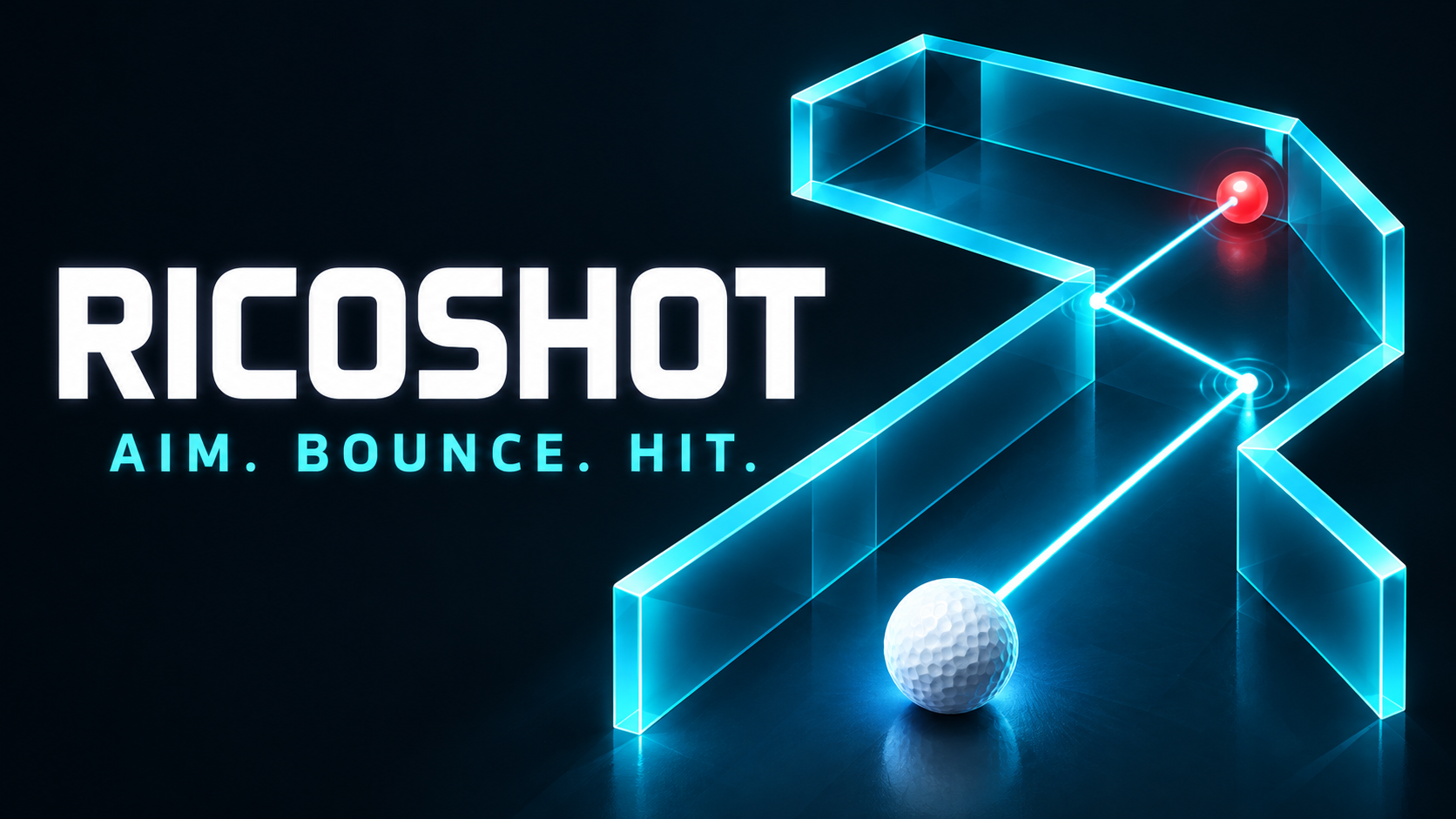
Even in a game like RICOSHOT: Golf Puzzle, which visually shows the ball's predicted bounce path, the satisfying feeling of "it hit" is complete only when a short sound plays at the moment the ball strikes a wall and changes direction. The eyes handle the calculation and the ears handle the sensation.
Closing Thoughts
The easiest way to understand game sound design is to play your favorite game for five minutes with the sound off and five minutes with it on. The difference is exactly what the sound designer made. Well-made sound is so natural you don't remember it, but without it, only half the game remains.